There is almost no case where these two are genuinely competing. PLA is easier on every axis and fails outdoors; ASA is harder on every axis and is the material outdoor parts are made from.
How this page is funded. Buy links go to Amazon and we earn a commission on qualifying purchases at no extra cost to you. Commission never decides an order or a score, we accept no free products or sponsored placements, and every roundup names something to skip. Full disclosure.
The picks, ranked
The picks, ranked
#
Product
Best for
Score
Price
1
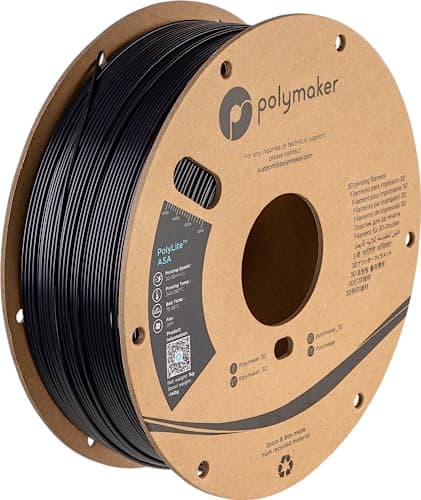
Polymaker PolyLite ASAThe material outdoor parts should be printed in. Needs an enclosure and ventilation.UV and chemical resistance
Published printing parameters by material, from Prusa Research's filament material guide. Ranges are the manufacturer's published envelopes, not a recommendation for your specific spool — every brand publishes its own narrower window inside these. Figures from Prusa Research, retrieved 2026-09-01.
One rule covers most of it
If the part lives indoors, PLA. If it lives outdoors, ASA. The overlap is small enough that most of this page is about what to do when you cannot print ASA.
Prusa list PLA's noted property as low warping and ASA's as UV and chemical resistance Prusa Research, which is exactly the trade: ease against durability.
Why PLA fails outdoors
Heat. PLA softens at a lower temperature than any other common printing material, and a dark part in summer sun runs far hotter than the air. It sags.
Ultraviolet light. UV breaks polymer chains at the surface, turning the part chalky and brittle.
Thermal cycling. Day-night expansion works on the layer bonds, which is why outdoor parts fail along a layer line months after they looked fine.
Water is not on that list, which surprises people — see is PLA waterproof.
What ASA costs you
Prusa publish 220 to 275 C nozzle and 90 to 110 C bed with an enclosure recommended Prusa Research. In practice that means:
An enclosure, closed for the whole print
Ventilation, for the styrene compounds
A bed that reaches 100 C or more reliably
Dealing with warping, which is ASA's defining printing difficulty Prusa Research
PETG does not soften in the sun the way PLA does and prints on any open machine. Its weakness is UV: it is not stabilized as standard, so a part in direct sun gets brittle at the surface over a year or so.
For a shaded outdoor part, a seasonal part, or anything you are happy to reprint, that is a genuinely reasonable answer and it needs no new hardware at all.
Indoors, ASA is the wrong choice
It is worth saying the reverse too. For an indoor part, ASA buys you nothing PLA does not already provide, and costs you an enclosure, a ventilation requirement, warping, and worse detail and overhangs.
Using a difficult material where an easy one works is a common way to make printing worse. Match the material to the environment, not to which datasheet reads best.
Every pick, in detail
01
Polymaker PolyLite ASA
Polymaker
Anything outdoors · 8.9/10 our fit score
The right answer for a part that lives outside. It is ABS that does not go yellow and chalky in sunlight.
Published specifications for Polymaker PolyLite ASA
UV resistance is the entire point and it is real — Prusa contrast it directly with ABS, whose outdoor parts "turn yellowish and more brittle over time"
Warps less and smells less than ABS at the same temperatures
What it does not
Needs an enclosure and a hot bed; this is not a material for an open printer in a cold room
More expensive per kilogram than the PETG that would do the job for many outdoor parts
Sealing does not solve either failure mode. Heat is a bulk property of the polymer, and UV reaches the surface through any practical coating over time. Paint can slow surface degradation; it does not stop a part sagging in the sun.
+ − Do I need an enclosure for ASA?
Prusa mark one as recommended, and large ASA parts warp badly without still air. If you do not have one, PETG for a season is a more realistic plan than ASA printed in a draft.
+ − Is ASA worth using indoors?
No. Indoors it buys nothing PLA does not provide, and costs an enclosure, ventilation, warping and worse detail. Match the material to the environment.