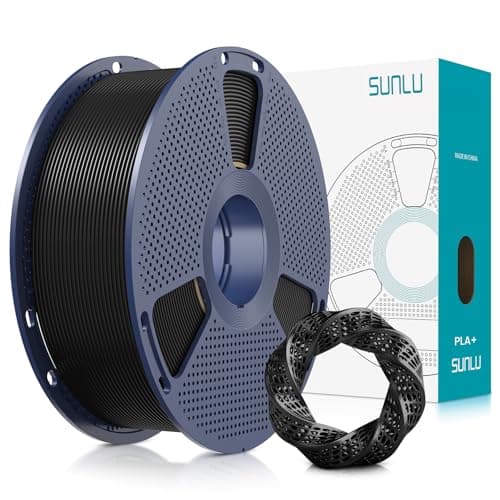
If the printer sits in a room you sleep, work or eat in, print PLA — UL's Chemical Insights Research Institute names it as the filament that emits fewer contaminants, and a toughened grade like SUNLU PLA+ costs no more than the alternatives. ABS, ASA and nylon are the materials that genuinely need extraction, and the honest answer for a bedroom printer is to not buy them.
How this page is funded. Buy links go to Amazon and we earn a commission on qualifying purchases at no extra cost to you. Commission never decides an order or a score, we accept no free products or sponsored placements, and every roundup names something to skip. Full disclosure.
The picks, ranked
The picks, ranked
#
Product
Best for
Score
Price
1
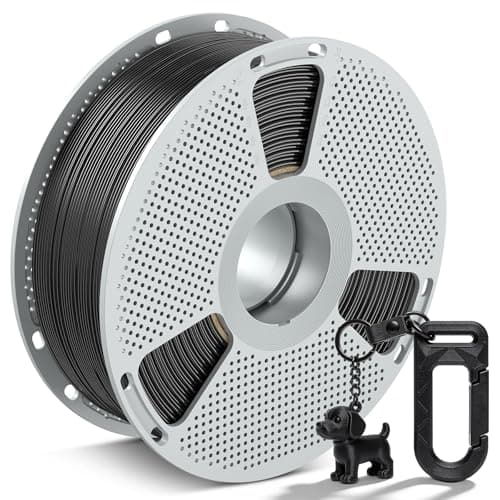
SUNLU PLA+PLA is the material UL name as emitting fewer contaminants, and it prints at the lowest temperature of anything here — the two variables their research ties emissions to.185-235 C nozzle, no enclosure
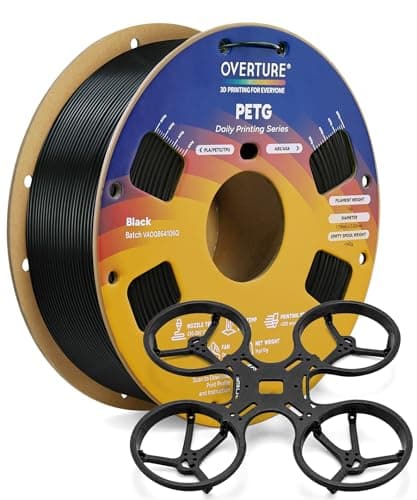
Overture PETGPrusa list no enclosure requirement for PETG. It runs hotter than PLA and does produce a noticeable smell, so it wants an open window rather than extraction.215-270 C nozzle, no enclosure
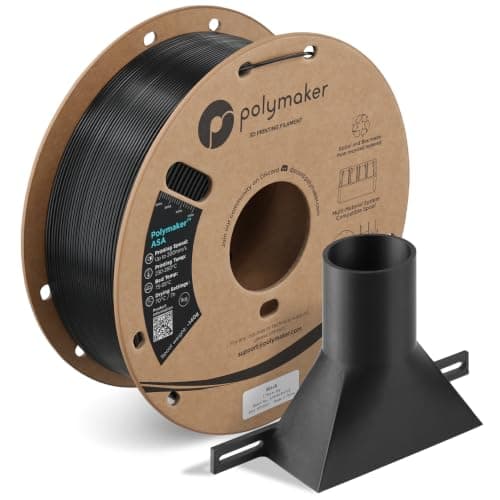
Polymaker PolyLite ASAThe right material for a part that lives in sunlight and the wrong material for an unvented room. Buy it with a plan for where the air goes, not before.Enclosure recommended, 220-275 C
Best outdoor material, but only with real extraction
SUNLU Easy PA NylonUL name nylon alongside ABS as releasing significantly more particles and VOCs than PLA. Worth it for real mechanical duty, not worth it in a bedroom.Enclosure recommended, 240-285 C
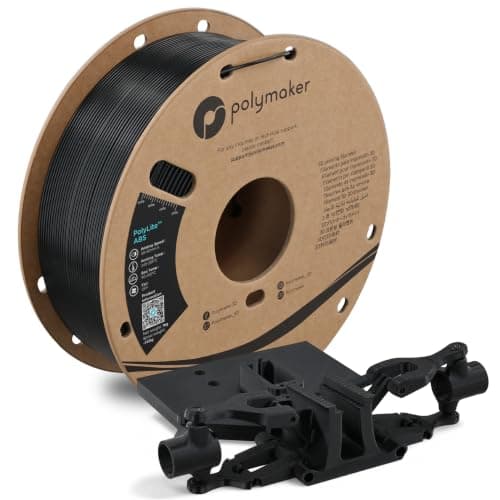
Polymaker PolyLite ABSABS is the material this question exists because of, and we point most people at ASA anyway for UV resistance. If you cannot vent outdoors, this is the spool to not buy.Enclosure recommended, 230-255 CSkip this
Published printing parameters by material, from Prusa Research's filament material guide. Ranges are the manufacturer's published envelopes, not a recommendation for your specific spool — every brand publishes its own narrower window inside these. Figures from Prusa Research, retrieved 2026-09-01.
What the published research actually says
The most useful public body of work on this is from the Chemical Insights Research Institute at UL Research Institutes, which both measures desktop printer emissions and wrote the test method for them. Four of their findings decide this page Chemical Insights Research Institute (UL Research Institutes).
Emissions track two variables. In their words, the magnitude of emissions is directly tied to the nozzle temperature and the filament type being used. Not the brand, not the color first — the temperature and the polymer.
PLA is the lower-emitting choice. They state that PLA generally emits fewer contaminants, which makes it a safer material choice.
ABS and nylon are the higher-emitting ones, because they print at higher temperatures, and they release significantly more ultrafine particles and volatile organic compounds.
The scale is not trivial. Their research found particle emissions reaching up to one trillion particles per hour, across more than 200 distinct VOC species, and in poorly ventilated spaces the fine-particle concentration near an operating printer can exceed outdoor levels beside a busy highway.
The ranking, by what the room has to provide
PLA: a room you live in
Prusa publish 185 to 235 C at the nozzle for PLA and no enclosure requirement Prusa Research. It is the coolest-running common filament and the one UL name as lower-emitting. That combination is why a PLA printer in a spare bedroom is the normal arrangement and nobody argues about it.
“Lower-emitting” is not “zero”. UL’s own guidance still applies to a PLA printer: run at the lowest nozzle temperature that gives acceptable quality, and limit the time you spend beside a running machine, because particle emission rates peak in roughly the first twenty minutes of a print Chemical Insights Research Institute (UL Research Institutes). Both of those are free.
PETG: a room with a window you open
PETG carries no published enclosure requirement either Prusa Research, which is the whole reason it is our default recommendation for parts PLA cannot handle. What it does do is run up to 270 C and produce a smell most people notice. Our PETG hub is blunt about that being a real barrier for some setups.
Treat PETG as the material where ventilation stops being optional and starts being sensible: an open window, or a printer that is not in the room you sit in all evening.
ABS, ASA, nylon and polycarbonate: extraction, or don’t
These four are the materials Prusa mark as recommending an enclosure Prusa Research, and the enclosure requirement and the ventilation requirement arrive together. ABS and ASA are styrene-based copolymers running at 230 to 275 C; nylon runs to 285 C and polycarbonate to 275 C. Our ABS page states the requirements before anything else for exactly this reason.
The honest framing is a purchase decision, not a safety lecture. If you have a vented enclosure, these are excellent materials and you should use them. If you do not, the answer is not “print them carefully and open a window” — it is to buy a different spool. For outdoor parts that is still ASA and you should solve the venting. For most other reasons people reach for ABS, PETG gets you most of the way without the requirement.
What an enclosure actually removes
A bare enclosure is a thermal device: it keeps the chamber warm and still so ABS does not warp. It is not an air-quality device. The numbers only arrive when the enclosure is ventilated or filtered, and then they are large: UL cite research finding a ventilated enclosure reduced particle concentration by 99.7% and total VOC concentration by 69.5%, and filtration systems reducing maximum particle concentration by 95% or more Chemical Insights Research Institute (UL Research Institutes).
Read those two figures together, because the gap between them is the point. Particles are easy to catch. VOCs are much harder — 69.5% against 99.7% — which is why their guidance pairs a HEPA filter for particles with activated carbon for the gases, and why the best version is still ducting the air outdoors rather than cleaning it and returning it to the room.
The standard nobody mentions: UL 2904
There is a published test method for this. UL 2904 is the standard for testing and assessing particle and chemical emissions from 3D printers, with performance criteria for identifying low-emitting machines intended for non-industrial spaces like offices and classrooms, and it runs as a detailed two-day protocol covering ultrafine, fine and coarse particles plus VOCs and aldehydes Chemical Insights Research Institute (UL Research Institutes).
Their recommendation is to buy printers verified against it. We will add the honest caveat: very few consumer printers advertise UL 2904 verification, so for most readers this is a thing to ask about rather than a filter you can shop with today. The filament choice in the ledger above is the lever you actually have.
Smell is not the measurement
The most common mistake in this topic is treating odor as the sensor. PETG smells more than PLA to most people and is not the more dangerous of the two. The ultrafine particles that UL measure are, by definition, below the size that produces any sensation at all, and their research ties the magnitude to nozzle temperature and polymer rather than to how strong the print smells Chemical Insights Research Institute (UL Research Institutes).
Use the table, not your nose. A hot, odorless print is not safer than a cooler, smellier one.
If the printer is a resin printer, this is the wrong page
Photopolymer resin is a different hazard with different controls — skin sensitization that builds up over months, and a disposal obligation. Formlabs publish the clearest public guidance and we summarize it on resin printing safetyFormlabs. UL’s own instruction for the resin side is narrower and worth repeating here: wear chemical-resistant gloves when handling uncured resin or the solvents you wash it in Chemical Insights Research Institute (UL Research Institutes).
The verdict in one paragraph
Buy PLA for a printer that shares a room with you, and run it at the low end of its temperature range. Buy PETG when PLA is not tough enough and open a window. Buy ABS, ASA, nylon or polycarbonate only when the part genuinely needs what they offer and you have somewhere for the air to go — a filtered enclosure gets you most of the way on particles and far less of the way on gases, and ducting outdoors is the real answer. If you cannot do that, the right move is to change the spool rather than to hope.
Every pick, in detail
01
SUNLU PLA+
SUNLU
Best for a printer in a room you live in · 9.1/10 our fit score
The cheapest filament we would load without flinching, and the reason most people never need to spend more.
UV resistance is the entire point and it is real — Prusa contrast it directly with ABS, whose outdoor parts "turn yellowish and more brittle over time"
Warps less and smells less than ABS at the same temperatures
What it does not
Needs an enclosure and a hot bed; this is not a material for an open printer in a cold room
More expensive per kilogram than the PETG that would do the job for many outdoor parts
It depends on the filament. PLA is named by UL’s Chemical Insights Research Institute as emitting fewer contaminants and carries no published enclosure requirement, so a PLA printer in a normally ventilated room is the standard arrangement. ABS, ASA, nylon and polycarbonate all recommend an enclosure and release significantly more particles and VOCs, and those genuinely need extraction.
+ − Is 3D printing with PLA safe indoors?
It is the safest common choice, not a zero-emission one. UL state that PLA generally emits fewer contaminants, and it runs at the lowest nozzle temperature of any mainstream filament, which is the other variable their research ties emissions to. Their free precautions still apply: use the lowest temperature that prints well, and do not sit beside the machine during the first twenty minutes, when particle emission rates peak.
+ − Does an enclosure stop 3D printer fumes?
Only if it is ventilated or filtered. A bare enclosure is a thermal device that stops ABS warping. UL cite research where a ventilated enclosure cut particle concentration by 99.7% and total VOCs by 69.5%, and filtration cut peak particle concentration by 95% or more. Note the gap between those two numbers: particles are easy to capture and gases are not, which is why HEPA plus activated carbon is the pairing, and ducting outdoors is better than either.
+ − Which filament smells the least?
PLA, but smell is the wrong test. Ultrafine particles are below the size that produces any sensation, and UL tie emission magnitude to nozzle temperature and polymer type rather than to odor. PETG smells more than PLA and is not the more hazardous of the two. Choose on the material table, not on the smell.
+ − Will a dust mask protect me from 3D printer emissions?
No. UL state plainly that standard dust masks are not effective for filtering ultrafine particles or volatile organic compounds. Ventilation, filtration and material choice are the controls that work; a nuisance mask is not one of them.